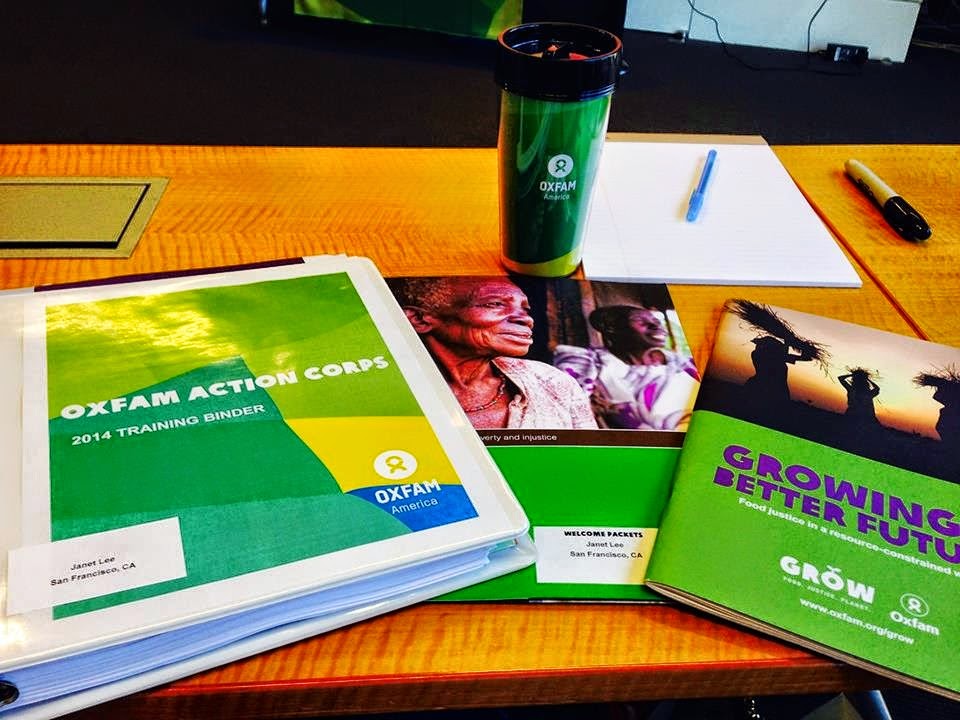
Tuesday, January 29, 2013

Become an Oxfam Action Corps Organizer!


Oxfam America now accepting applications for new Action Corps organizers for 2013-14. Apply now and, if chosen, get a FREE trip to Washington DC for training! Check out the message from Oxfam America below for more information.


Are you concerned that the people who grow the world’s food—many of whom are women—cannot afford to feed their own families? And that one in eight people goes to bed hungry every night even though the world produces enough food for everybody?

Do you want to take action in your city to achieve policies to sustainably feed a growing population and empower poor people to earn a living, feed their families and thrive?

Are you willing to reach out to others in your community to hold governments and businesses accountable for the impact of their policies and practices on the environment and global food security?

Oxfam invites you to join the Oxfam Action Corps, an exciting effort to cultivate grassroots leaders and political change.

Volunteers with the Oxfam Action Corps lead a coordinated charge to improve national legislation and business practices, and to deepen local community resources for fighting poverty and injustice.

When you volunteer with the Oxfam Action Corps, you take actions like: hold a house party or collect signatures at a concert. You can lead a delegation to a lawmaker's local office, organize a petition drive, or plan an Oxfam America Hunger Banquet. Anyone is welcome to volunteer, regardless of age or experience level—all you need is a willingness to make a difference.

Volunteers receive continuing support from Oxfam, including campaign materials, strategy tips, and advice on community organizing. Each city has two trained volunteer corps organizers who welcome and orient volunteers throughout the year.
Other responsibilities of a corps organizer:
Work with other lead organizers and volunteers on a local level
·         Help convene activities focused on Oxfam’s GROW campaign
·         Follow policy developments and messaging
·         Update blog, email announcements and social media sites with events and news
·         Create plans for local action  
·         Lead outreach at public events like concerts and conferences
·         Build relationships with like-minded organizations
·         Gather volunteers for regular planning sessions
·         Cultivate leadership in others
·         Work within budget to accomplish goals
·         Maintain strong, regular communication with Oxfam staff including tracking and reporting on activities

What volunteers have to say: “Oxfam Action Corps has really helped me professionally.  Before the training I was working as an administrative assistant and never got a chance to take charge of an event.  With Oxfam Action Corps I got to lead an event, reach out to allies.  It prepared me for a huge career change, directing a small non-profit.” - Jessica Lettween, from Minnesota.

“This is leadership in practice.  You can’t just read a book on leadership.  You have to put it into practice. You should see how I list this on my resume!” - Jill Mizell, NYC

Saturday, December 29, 2012

Day of Action at Harvesters

The Action Corps had the opportunity to volunteer at Harvesters in December, and it was a wonderful experience!

Harvesters is a community food network that serves 26 counties in northeastern Kansas and northwestern Missouri. It is the only food bank/network that serves this area, and it works with 620 member agencies to acquire and distribute food to those in need. Check out this fact sheet to learn more.

While we were at Harvesters, we learned about the organization and were given a tour of their warehouse facility. Needless to say, they can and do house and move a TON of food and disaster supplies. It truly is an awe-inspiring operation, and we in Kansas City are incredibly fortunate to have such an organization in our city.

The Action Corps was put to work on assembling kits for the BackSnack program. For children that receive free and reduced-price lunches at school, getting enough to eat over the weekend can be incredibly tough. BackSnack was created to help bridge the meal gap from Friday to Monday. Each bag is packed with shelf-stable, no-cooking-required snacks and meals to get kids through Saturday and Sunday with the nourishment they need to come back to school on Monday ready to learn. Currently, BackSnack serves 19,000 children each week, and the number is anticipated to grow.

As volunteers, we worked an assembly line to put together as many kits as possible in 2 hours. We were paired up with a Girl Scout troop and their parents, and, together, we made hundreds of BackSnacks! Helping Harvesters with BackSnack was a lot of fun for us, and incredibly helpful for them. We hope to make it back soon to further help this great organization!

Hunger Banquet at Avila University

On November 19th, the Kansas City Action Corps had the privilege to attend a Hunger Banquet as the guest speakers. The Hunger Banquet was put on by the Student Social Work Association at Avila University in South Kansas City, MO.

For those who have never heard of or attended a Hunger Banquet, it can be a very powerful event. Hunger Banquets are an interactive tool that can demonstrate visually the food inequalities people live with daily around the world. As participants enter the event, they randomly draw a card assigning them to an income level. The majority of participants will be assigned to the lowest income level, and a smaller proportion to the middle income level. The smallest group of attendees will be assigned to the highest income level. Once everyone is seated, a meal is served to represent the participants' assigned incomes. Those at the highest level receive a full, balanced meal and "fancy" beverages (juice or soda), while seated at a nicely-set table. Those with the mid-level income are given rice, beans, and water while seated in chairs. Finally, those with the lowest income must sit on the floor while served only rice and a communal pitcher of water.

For our contribution, the Action Corps spoke a bit about Oxfam International and Oxfam America, as well as the GROW Method and Campaign. We also did our best to answer any questions the students and faculty had concerning Oxfam America and their work. The event hosted nearly 30 participants and, we feel, did a really great job exemplifying why Oxfam does the work they do around the world.

On a final note, we want to thank the Student Social Work Association and Avila University for hosting this event and using it as a food drive for Harvesters. We were able to contribute about 3 full boxes of food to the food bank thanks to the particpants of the Hunger Banquet. Nice work everyone!


Low Income Group

High Income Group


Middle Income Group (foreground, in chairs)


.

Tuesday, December 4, 2012

Working the Farm with Cultivate Kansas City

The Kansas City Oxfam Action Corps had the pleasure of participating in a Work the Farm day at the Gibbs Road Community Farm in Kansas City, KS. Including Lauren and myself, we had 6 volunteers helping with a variety of tasks to get the farm ready for the winter.

Emma & Cody, along with two other community volunteers,
separate garlic cloves for planting.


We were able to help Gibbs Road Community Farm plant multiple rows of garlic, seed microgreens in their greenhouse, and even unload hay bales during a well-timed delivery.

Lauren & her sister, along with other community volunteers,
plant seeds that will become tasty microgreens!


Cultivate Kansas City is a wonderful non-profit organization that works to get local, organic food in the hands of Kansas Citians, either by promoting farmers markets or teaching people to be urban farmers.

Sarah Dehart, part of the field crew at the Gibbs Road Community Farm,
teaches volunteers how to measure and correctly space the beds they're planting.

For more information on Cultivate Kansas City or volunteering at the Gibbs Road Community Farm, check out their website. And for more photos from this volunteer day, and other Cultivate Kansas City events, take a look-see at their Flickr stream.

Thank you so much for having the Oxfam Action Corps at your farm, Cultivate Kansas City! We had a great time getting our hands dirty!

Monday, November 12, 2012

Sandy shows similarity, and differences, between neighboring nations


The hurricane showed the common ground between the US and Haiti. But I wonder if both of the countries I love can recover from the storm.  
November 7th, 2012

Hurricane Sandy brought flooding to Haiti. Photo: Reuters/Swoan Parker, courtesy the Thomson Reuters Foundation – AlertNet

Sophia Lafontant is Oxfam America’s lead organizer for Haiti.

It is amazing how quickly life can change. In a matter of hours, people in New York’s Breezy Point, The Rockaways and Staten Island, in New Jersey’s Atlantic City, in Cuba, Jamaica, and Haiti were all faced with the reality of lost property, death, and power outages. It makes me realize how interconnected we all are and dependent on our families, friends, elected officials, and the kindness of strangers to help us when we cannot help ourselves.

I live in Washington, D.C., and while Sandy came through here too, it was not with the same force.  While holed up in my apartment for the better part of two days, my mind and thoughts often raced to Haiti, where 54 people reportedly died in the storm, and my extended family and friends still there. Both my parents were born and raised on the island and came to the US as young adults to escape the repressive government of Jean Claude Duvalier. Like many children of immigrant parents, I was raised with one foot in the US and one foot in Haiti. Despite the extreme differences, I love both countries dearly. As an American, I cherish the opportunities and freedoms I have had all my life living here. But Haiti, the land of my parents’ birth, pulls at my heart strings constantly. And the storm, in an odd way, brought into focus for me the sudden similarities in these neighboring nations: the anxiety, fear, loss, suffering, and high-level discussions about if and how to rebuild.

In both the US and Haiti, governments demonstrated leadership. New Jersey  Governor Chris Christie, New York City Mayor Michael Bloomberg, Haitian President Michel Martelly, and Haitian Prime Minister Laurent Lamothe all deployed whatever human, physical, and financial resources they had at their disposal to evacuate residents living in low lying areas and to provide shelter, food and water to citizens in their care.

According to the New York Times, Sandy’s estimated to cost the US economy is $50 billion. President Obama has pledged to cut red tape and ensure that aid reaches the needy quickly. The Federal Emergency Management Agency has already distributed $19 million for temporary housing aid to 85,072 storm survivors. The Department of Labor is making $16 million available to hire temporary workers for the cleanup and the Department of Transportation is giving $17 million to five states to support the rebuilding and repair of transportation infrastructure vital to the movement of people, goods and services. For US citizens there is comfort in knowing the government is capable of responding swiftly to a disaster.

But when I read what Haiti’s Lamothe told Reuters–“Sandy’s impact was devastating… most of the agricultural crops that were left from Hurricane Isaac were destroyed during Sandy“– it was like someone punched me in the gut. With all that Haiti has to fix and all that it was in the process of fixing since the 2010 earthquake, I wanted to throw my hands up in frustration. What is Haiti, a poor country with limited resources and a vulnerable environment, going to do?

The full cost of Sandy to Haiti may not be known for weeks. One estimate has it at $104 million. In some areas, Sandy brought rains equivalent to 50 percent of yearly rainfall, destroying houses, schools, bridges and roads. And then I read just the other day that 70 percent of Haiti’s crops were lost. The agricultural sector which this year alone has had to deal with drought, tropical storm Isaac, and hurricane Sandy has been dealt its latest blow. My fear, and that of others, is that Sandy will increase food prices and further the demise of small farmers—adding one more burden to a country that is already shouldering far more than its share of hardship.

This post was first published on the First Person blog published by Oxfam America.

Thursday, October 18, 2012

Dig In! KC

The Kansas City Action Corps' newest organizer, Lauren, had the opportunity to attend a fundraiser for Cultivate Kansas City. Check out what she had to say about the event!


On Sunday, September 23rd, I had the opportunity to attend Dig In!, KC, an annual fundraiser for Cultivate Kansas City.  Cultivate Kansas City is a non-profit organization that grows local food in addition to teaching the community tips on how to manage your own garden.  I was attending on behalf of Oxfam to make connections in the community and to support Cultivate Kansas City’s work.  Oxfam has introduced the Grow Method, which focuses on supporting local farmers and buying locally grown foods in order to be more sustainable.   

The event allowed for time in the beginning to shop at local farmers booths that had been invited to the event.  I took home a variety of different foods being sold including; basil, apples, okra, and salsa.  Everything I took home was delicious and I received more than what I would have paying the same at a grocery store.  After allowing time to shop and talk with the different farmers the event proceeded to the dinner prepared by chefs that use many of the ingredients that were supplied by the farmers at the booths.  The dinner included many courses of delicious, fresh food that were enjoyed under the stars at the Historic City Market. 
            
Oxfam supports local farmers in their initiative to lessen global hunger.  Cultivate Kansas City’s work is an important facet within the community and whose work not only affects the Kansas City community but the world. 


Tuesday, September 11, 2012

Food Justice


Food Justice by Shayla Price

There's enough food in the world to feed everyone. So, why do individuals go hungry?

Huge imbalances in access to fertile land and water exist. Farmers and consumers do not hold the power to control these vital resources. Instead, companies and governments possess authority over the global food system. They often determine who eats and who doesn't.

Oxfam's GROW Campaign advocates for food justice. Here are a few goals of the campaign:

  • Increase the productivity, self-reliance, and economic opportunity of small-scale farmers;
  • Increase farmers' access to resources like water and land; and
  • Modernize our food aid programs so they are more effective, efficient, and fiscally responsible.

Watch the video to learn how Oxfam America is working together with others to end poverty and injustice. Also,  get involved by taking the Oxfam GROW Pledge!